
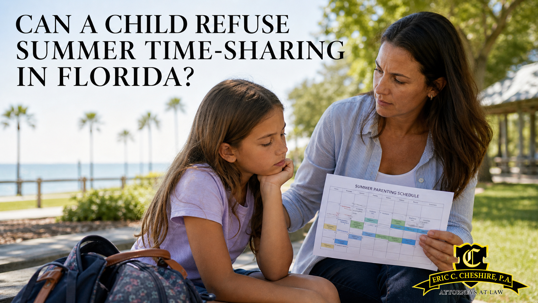
Can a Child Refuse Visitation or Summer Time-Sharing in Florida?
Can a child refuse visitation or summer time-sharing in Florida? A child’s feelings may matter, but a child usually cannot simply cancel a court-ordered parenting schedule. Unless there is a real safety concern, the parent with the child is normally expected to encourage the child to follow the time-sharing order.
The better question is not just, “Can the child refuse?” The better question is, “Why does the child not want to go?” A child who is bored, anxious, missing friends, or struggling with a schedule change needs a different response than a child who is reporting abuse, neglect, unsafe supervision, substance abuse, or fear.
Key Takeaway
When a child resists summer time-sharing, parents should not panic, punish the child, ignore the court order, or take matters into their own hands. The safer path is to ask why the child is resisting, encourage a healthy relationship with the other parent when it is safe, document what is happening, and seek legal advice quickly if there are serious safety concerns.
If the refusal has already turned into missed exchanges, denied parenting time, or repeated schedule problems, our related guide on summer time-sharing problems in Florida explains what parents should document and when enforcement may need to be considered.
Can a Child Decide Not to Follow the Parenting Plan?
Usually, no. A child does not get to overrule a court-ordered parenting plan because they do not feel like going.
This is a common misunderstanding. Parents sometimes believe that once a child reaches the teenage years, the child can choose where to stay. That is usually not how it works.
A child’s preference may matter in some situations, depending on the child’s age, maturity, and understanding. But preference is not the same thing as legal authority to ignore the parenting plan.
Under Florida Statute § 61.13, Florida courts consider the child’s best interests, including each parent’s ability to encourage a close parent-child relationship and honor the time-sharing schedule.
What Should a Parent Do When a Child Says They Do Not Want to Go?
Start by listening. Do not dismiss the child’s feelings, but do not assume the parenting plan no longer applies.
A parent can calmly ask:
- What is making you feel this way?
- Did something happen that made you uncomfortable?
- Are you worried about missing your friends?
- Are you bored when you are there?
- Are you safe when you are there?
Many children resist summer time-sharing for ordinary reasons. They may be bored, miss friends, dislike different house rules, or feel awkward with a new spouse, partner, or step-sibling. Those concerns should be taken seriously, but they usually do not justify refusing court-ordered time-sharing.
How Should a Parent Encourage the Child to Go?
If the child is safe and there is no abuse, neglect, or serious risk of harm, the parent should usually encourage the child to spend time with the other parent.
A parent might say:
“I understand that you would rather stay here today, but this is your time with your other parent. It is important that you have that relationship. Let’s talk about what is bothering you, but we still need to follow the schedule.”
A parent should avoid saying, “You do not have to go if you do not want to,” “Tell the judge you want to stay with me,” or “I cannot make you go.” Those comments can place the child in the middle and make the resisting behavior worse.
What If the Child Has a Real Safety Concern?
Safety concerns must be handled differently.
If a child is reporting abuse, neglect, unsafe supervision, substance abuse, domestic violence, or another serious risk, the parent should seek legal advice as soon as possible. Depending on the facts, the parent may also need to contact DCF and/or law enforcement.
A parent should not ignore serious concerns just because there is a parenting plan. But a parent should also be careful about making unilateral decisions without legal guidance unless immediate safety requires urgent action.
Can a Parent Get in Trouble for Letting the Child Refuse?
Yes. If a parent repeatedly allows or encourages a child to refuse time-sharing without proper cause, the court may view that parent as violating the parenting plan. The problem can become more serious if the parent is subtly supporting the refusal or speaking negatively about the other parent.
Repeated interference can harm the child’s emotional well-being. It can also expose the parent to a contempt claim or other court action. In some cases, repeated interference may become part of a request to modify time-sharing.
This is also where concerns about parental alienation may arise. Not every child refusal is parental alienation. But if one parent repeatedly influences, pressures, rewards, or allows the child to reject the other parent without proper cause, an expert may find that alienating behavior is occurring.
What Should Parents Document?
Both parents should document what happens. The parent being denied time-sharing should keep records of missed exchanges and requests for makeup time. The parent with the child should document what the child said and what was done to encourage the exchange.
Helpful records include missed exchange dates, texts, emails, parenting app messages, what the child said, efforts to encourage the child to go, requests for makeup time, safety concerns, and any contact with legal counsel, DCF, or law enforcement.
Do not exaggerate. A simple timeline is often more effective than a long emotional message.
When Should a Parent Speak With a Florida Family Law Attorney?
A parent should consider speaking with a family law attorney when child refusal becomes repeated, emotional, unsafe, or tied to allegations about the other parent.
Legal guidance may be especially important when a child repeatedly refuses summer time-sharing, a parent is denied court-ordered time, a teenager claims they can choose where to live, the other parent is not encouraging the child to go, the child reports abuse or fear, or enforcement or modification may be necessary.
If the parenting plan itself is unclear, a more detailed Florida parenting plan may help reduce future conflict by addressing summer schedules, exchange rules, communication, travel, and recurring time-sharing problems.
FAQs About Child Refusal and Summer Time-Sharing in Florida
Can a teenager refuse to visit a parent in Florida?
A teenager’s preference may matter in some situations, but a teenager usually cannot simply cancel court-ordered time-sharing. Parents should still follow the parenting plan unless there is a serious safety issue or a court order says otherwise.
What if my child cries before going to the other parent’s house?
Crying should be taken seriously, but it does not automatically mean time-sharing should stop. Ask why the child is upset, encourage the relationship when safe, and document repeated concerns.
Talk With a West Palm Beach Family Law Attorney
If your child is refusing summer time-sharing, or if the other parent is using the child’s refusal to deny your court-ordered parenting time, The Law Office of Eric C. Cheshire, P.A. can help you understand your options under Florida law.
We help parents in West Palm Beach and throughout Palm Beach County address parenting plans, time-sharing disputes, enforcement concerns, and child-focused family law issues.
To schedule a consultation, call The Law Office of Eric C. Cheshire, P.A. at (561) 677-8090 or fill out the contact form on our website.
When summer time-sharing concerns affect your child, your relationship, and your peace of mind, we are here to help you protect what matters most.