
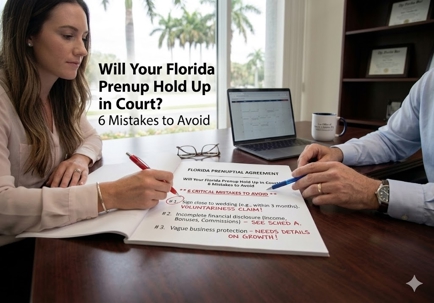
Will Your Florida Prenup Hold Up in Court? 6 Mistakes to Avoid
Will your Florida prenup hold up in court if it is ever challenged? Often it can, but only if the agreement was signed voluntarily, based on fair financial disclosure, and drafted clearly enough to match real life in Florida.
Couples usually raise prenups for practical reasons, not because they expect divorce. A family business is involved. One spouse expects family money or an inheritance. One spouse has children from a prior relationship and wants to protect what should pass to them.
If this conversation feels awkward, you are not alone. Done well, a prenup can reduce stress because it puts expectations in writing while you are aligned.
For the big-picture “why” in plain language, see our post Thinking About a Florida Prenup? Start the Conversation Before the Wedding.If you are curious what the prenup process typically looks like, our Prenuptial Agreements page explains the steps and the information we usually request.
Key Takeaway
A Florida prenup is strongest when both people had time, information, and real choice, and when the agreement is specific enough that a judge does not have to guess what the couple meant.
What “enforceable” means in Florida
Florida’s premarital agreement statute is Florida Statutes § 61.079. It requires a premarital agreement to be in writing and signed, and it describes what prenups can cover and the common grounds used to challenge enforcement.
In real cases, courts tend to look hard at three things:
- Timing and voluntariness (was it rushed or pressured?)
- Disclosure and knowledge (did both people know the financial reality?)
- Clarity and fairness of the terms (does it read like a clear agreement or a trap?)
The Florida Bar Journal has pointed out recurring pitfalls, especially last-minute signing and incomplete disclosure, including income.
Florida prenup strength checklist
Use this as a quick red-flag filter before you sign:
- Start the process well before the wedding.
- Exchange clear information about assets, debts, and income.
- Attach schedules and confirm they are part of the final signed version.
- Address business ownership and inheritance issues with specific language.
- Keep the signing process calm, documented, and free of pressure.
The 6 mistakes that can sink a Florida prenup
Mistake 1: Waiting until the wedding is too close
Late timing invites a simple argument: “I signed because I was boxed in.”
What it looks like
- The prenup appears after deposits are paid or family has booked travel.
- Someone is told, “Sign this or the wedding is off.”
What helps
- Start months ahead and leave time for review and revisions.
Mistake 2: Treating disclosure like a formality
Florida’s statute provides a framework where disclosure and knowledge can matter, especially if a prenup is attacked as unconscionable. The Florida Bar Journal also warns that disclosure should include income, and that tax returns alone may not tell the full story.
What it looks like
- Salary is disclosed, but not bonuses, commissions, or distributions.
- Debts are described vaguely, without amounts.
What helps
- Use schedules for assets, liabilities, and income. If values are uncertain, disclose what you know and explain the estimate.
Mistake 3: Vague language about a family business
A one-line clause like “the business stays mine” often does not cover how businesses really operate.
What it looks like
- No plan for growth, reinvestment, or distributions.
- No clarity if one spouse works in the business or marital funds support it.
Florida Statutes § 61.079 allows couples to contract about property rights and how property will be treated if the marriage ends.
What helps
- Define the business interest and address growth, compensation, distributions, and reinvestment in plain language.
Mistake 4: Protecting inheritance in theory, then commingling in practice
Commingling is the quiet way inheritances lose their “separate” character, usually through convenience.
What it looks like
- Inheritance goes into a joint account “temporarily.”
- A family gift becomes a down payment on a jointly titled home.
What helps
- Add “do not commingle” rules and practical steps (separate accounts, clean records, clear tracing).
Mistake 5: Wanting to protect children’s inheritance without coordinating the full plan
In blended families, a prenup can help, but it often needs to align with beneficiary designations and estate planning. Florida’s statute recognizes premarital agreements as part of estate planning arrangements.
What it looks like
- The prenup says one thing, but beneficiary designations say another.
What helps
- Match the prenup to the estate plan so the documents are not fighting each other.
Mistake 6: A messy process and no paper trail
When a dispute happens years later, the paper trail is what the court can see.
What it looks like
- Last-minute edits, missing schedules, unclear dates, or no record of what was exchanged.
- One spouse signs without meaningful opportunity for independent advice.
What helps
- Keep a clean timeline (drafts, disclosures, final signing) and ensure the signed version includes all attachments. In many cases, separate counsel for each spouse is a practical safeguard.
Two limits people misunderstand
- Child support: A prenup cannot adversely affect a child’s right to support.
- Parenting and time-sharing: Florida courts decide parenting issues based on the child’s best interests under Florida Statutes § 61.13, not a private contract between adults.
A brief note about alimony
Florida allows prenups to address spousal support, and the statute includes a safeguard if a waiver would make a spouse eligible for public assistance at the time of separation or divorce.
FAQs
1) If we sign close to the wedding, is it automatically invalid?
Not automatically. But tight timing can support a later claim of pressure or lack of voluntariness.
2) Do we have to disclose exact values for every asset?
Not always. Fair, clear schedules are the safer approach, including income, assets, and liabilities, with reasonable estimates when needed.
3) Can a Florida prenup protect a family business?
Yes. The key is specificity: growth, distributions, compensation, and how business and marital funds are handled.
4) Can a prenup decide child support or time-sharing?
No. Florida law limits premarital agreements on child support, and parenting issues are decided under the best-interests standard.
One clear next step
If you are considering a prenuptial agreement in West Palm Beach or elsewhere in Palm Beach County, contact The Law Office of Eric C. Cheshire, P.A. by filling out the contact form on our website and/or calling (561) 677-8090 to request a confidential consultation.